Wednesday, January 21, 2015

Champaner

The entrance to the Jama Masjid
For five years, while at college, I lived just 30 miles from Champaner and hadn't even heard of it! It is now rightfully, a world heritage site.

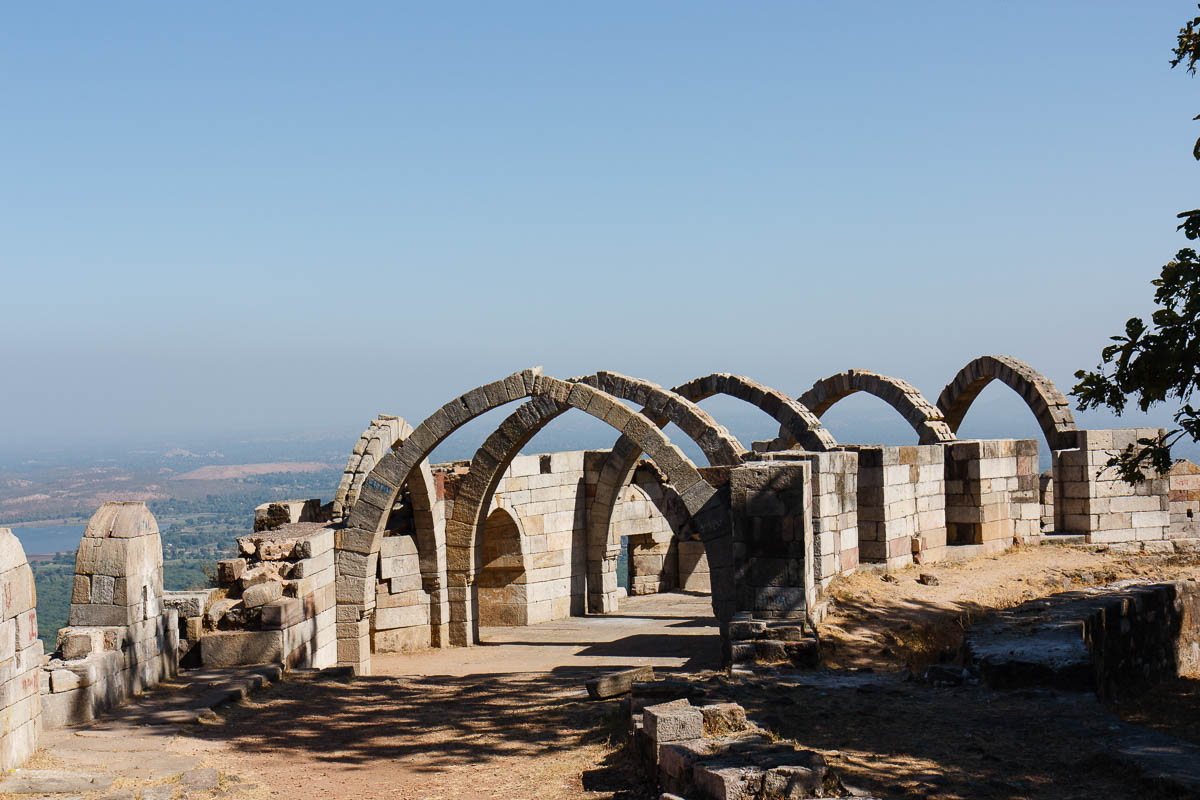
The town was founded in the 8th century, but the ruins we went to see were built in the late 15th and early 16th century by the Sultan of Gujarat, Mahmud Begada. The ruins, which were mostly mosques, are beautiful early examples of Indo-Islamic architecture.

The monuments are spread out over the city of Champaner and it took some work to find them. Two of the mosques, Nagina and Kavada required a mile or so walk through the fields and scrub forests. To get to the Kamani Masjid, we drove along a narrow dirt road hemmed in with thorny shrubs that had us worried about getting a flat.

The town of Champaner from Pavagadh
The ramparts of Pavadadh Fort
The Sahar-ki-masjid (city mosque)
A Mihrab in the city mosque -- a Mihrab is a symbolic gateway to Mecca & is always built in the wall facing Mecca


The very impressive Jama Masjid from the South side

...the North side

The courtyard & Jama Masjid
The interior of the mosque

Detail of the columns

A Mihrab at the Jama Masjid

A Jharokha (window)

One of the shorter minarets

Mihrab -- see the same motif repeated

Carvings at the base of the main minarets

Windows in the courtyard walls

Tami exiting from what would have been the ladies area

Details of the Jharokha
The Kamani mosque is mainly in ruins, but you can see the detailed carvings

I climbed the ruins of a minaret to get this shot -- the Pavagadh hill is in the background

The walk to the Kevda & Nagina Masjids were well worth it -- this is the Kevda Masjid

The same motif at the center of the Mihrab

Carving detail in the main minarets
The Nagina mosque is made of a white stone

One of the Mihrabs in the mosque
 
This masouleum near the Nagina mosque was exquisitely carved; the central dome is no more
Details
Details of one of the pillars

The helical step well


Friday, January 16, 2015

The Cribs of Goa


Text by Cedric & Tami.

Compared to the U.S., Christmas celebrations start very late in Goa. If you were to drive around in the days leading up to Christmas, you'd think that the Goans had forgotten about Christmas and that the holidays were going to be quite a somber affair. But on the 24th of December all the decorations come out, the evening lights turn on, and there is quite a contagious mood of celebration throughout the area.

It was this way when we were growing up too...the mad dash on the 24th to put up the decorations before leaving for midnight mass. The decorations remain in place for the full 12 days of Christmas, then are put away on January 6th.  During this festive Christmas period the focus is on visiting with friends and family, as well as feasting on of a variety of special dishes like the famed Goan sorpotel, and on delicious, labor-intensive homemade sweets like dodol and cul-culs.  There is also a New Years Eve mass to help everyone start the year of on the right foot.

The Christmas decorations in Goa have a strong religious theme, consisting primarily of stars, cribs (nativity scenes), and more recently, LED lights.  And while you can see the occasional Santa and snowman, these types of decorations are still few and far between...at least for now in South Goa.

Another Goan tradition, which I had been unaware of, is the cribs that are made for public display by local church congregations and neighborhood groups.  These cribs range from a simple Joseph, Mary, and Jesus-in-the-manager nativity scenes to large displays that included shepherds, wise men, palaces, etc. from familiar bible stories, and other elements from the local Goan village (huts, farms of live grass, forests, waterfalls, and even ponds with live fish!).   For many of the more elaborate cribs that we saw, there were long lines of people eagerly waiting just to view them each night.  Thank you Noel for driving us to see so many of these beautiful and creative Christmas displays!

And apologies to those who were expecting this post to be about the homes of the rich and notorious.

This simple crib was by our apartment

A scene from a more elaborate crib

This big display had real grass growing in the fields and catfish in the pond

A traditional Indian village is often included in the crib


A crib in a star.

An example of the primary outside house decoration -- lighted stars!

Wednesday, January 7, 2015

A Goan wedding to remember

By Tami & Cedric.

We had the honor of an invitation to a Goan Catholic wedding while in Goa. The bride is my sister-in-law's cousin and though we didn't know them, they extended us an invite and made us feel very welcome.

The Portuguese invaded and occupied Goa from the late fifteenth century till they were ousted in 1960. During the early years, they mass converted a large number of the native Indians to Christianity and to date, Catholics make up a significant portion of the Goan population. (The link is worth reading if you're Goan or just interested in the Portuguese/Catholic impact on the region).

The day before the wedding, we were invited to the bride's "Roas" ceremony (pronounced like roast without the last "t"). The ceremony starts with short prayer, after which, the bride is annointed with holy oil by her parents, close relatives, and the priest. Next coconut milk is applied to the bride by her parents, relatives & then friends. This symbolizes purity, and is also meant to make her skin & hair soft and beautiful. The coconut milk was applied carefully and lovingly by her parents, then the elders and applied more generously by sibling, relatives and friends. All throughout we felt the love for the bride. It was followed by songs & music performed by the guests - and dancing. Of course, it ended with a wonderful Goan dinner. By this time, we had been introduced to a lot of the family and felt quite at home.
Beginning with a prayer and a hymn
Holy oil being lovingly applied by the parents
A liberal application of coconut milk

To a dunking at the end.

Tami, Jo and Chinky singing along to the Sorpotel song

Members of the family are gifted musicians

That had people up and dancing.


The wedding took place in a beautiful chapel on a hill. My sister-in-law remembers walking up to this chapel on Sundays since there was only a very rough road. The road is still very narrow, but paved. Much of the wedding ceremony and reception would be familiar to anyone who has attended a western wedding.
The beautiful church where the wedding took place

Beautiful blue tile


The reception kicked off with the help of an MC, who introduced the couple and guided the party through the cake-cutting, bouquet and garter throwing, first dances, etc.  The music included waltzes, jives, traditional Goan ballads, and modern dance pop.

The bride and groom spent quite a bit of time on the dance floor, enjoying dances with wedding guests, family, and each other.  At one point, the men made a circle around the bride & took turns dancing with her, and the women did the same with the groom. After a while, the bridesmaids "broke" the men's circle to rescue the bride & reunite her with her husband. Near the end of the evening, the guests on the dance floor tied ribbons to the bride and groom and circled them while still dancing until they were good and properly bound. The night ended with the wedding guests wishing the bride and groom well, while getting final pictures taken to remember the joy and merriment of the evening.
Lots of waltzes and cha-cha-chas

The bride dancing with the men...

..and the groom with the women

The bridesmaids come to get the bride

Wrapping them in ribbons of love