Showing posts with label Agra. Show all posts

Wednesday, December 17, 2014

The Taj Mahal


Just when we think we're familiar with the layout of Moghul tombs based on what we've seen so far, Shah Jehan changes the format for the Taj Mahal. There is still the walled space that's roughly square, but the mausoleum is close to one side. There is the familiar four-square garden (char baug), but it is entirely in front of the monument. There is a mosque to the east of the Taj, and to preserve the symmetry, an identical building to the west that served as a guest house. The fourth side, across from the entrance, is along the banks of the Yamuna river. (Map) The mausoleum is built on a platform and the effect, along with the riverside location, is stunning. As you enter the complex, and gaze (yes, you do gaze) at the Taj, there is nothing behind it, but open sky.

As a friend put it - walking through the entrance arch and seeing the Taj is a knee jellying moment.

The gates open at sunrise and we got there in the dark to buy our tickets and wait in line. It paid off as we had a spectacular morning with no crowds. The interior, usually crowded, was empty. We leisurely admired the fine marble screens, relief sculptures and embedded stone work. (No photography allowed). Then we walked round and round the monument in amazement. In theory, you could just study one side since the Taj is perfectly symmetrical.

I last saw the Taj Mahal at age 15 and, while I was impressed, I don't think I fully appreciated its beauty at the time.

The Taj Mahal complex seen from across the Yamuna river in the late evening. The mosque is on the right, the rest house on the left, and you can see the main gate peeking out just right of the Taj.

A corner view

A view from below the platform.

I had to take one with an arch around it.

Around 10a with the sun higher in the sky and the ground more crowded
Close up of a minaret

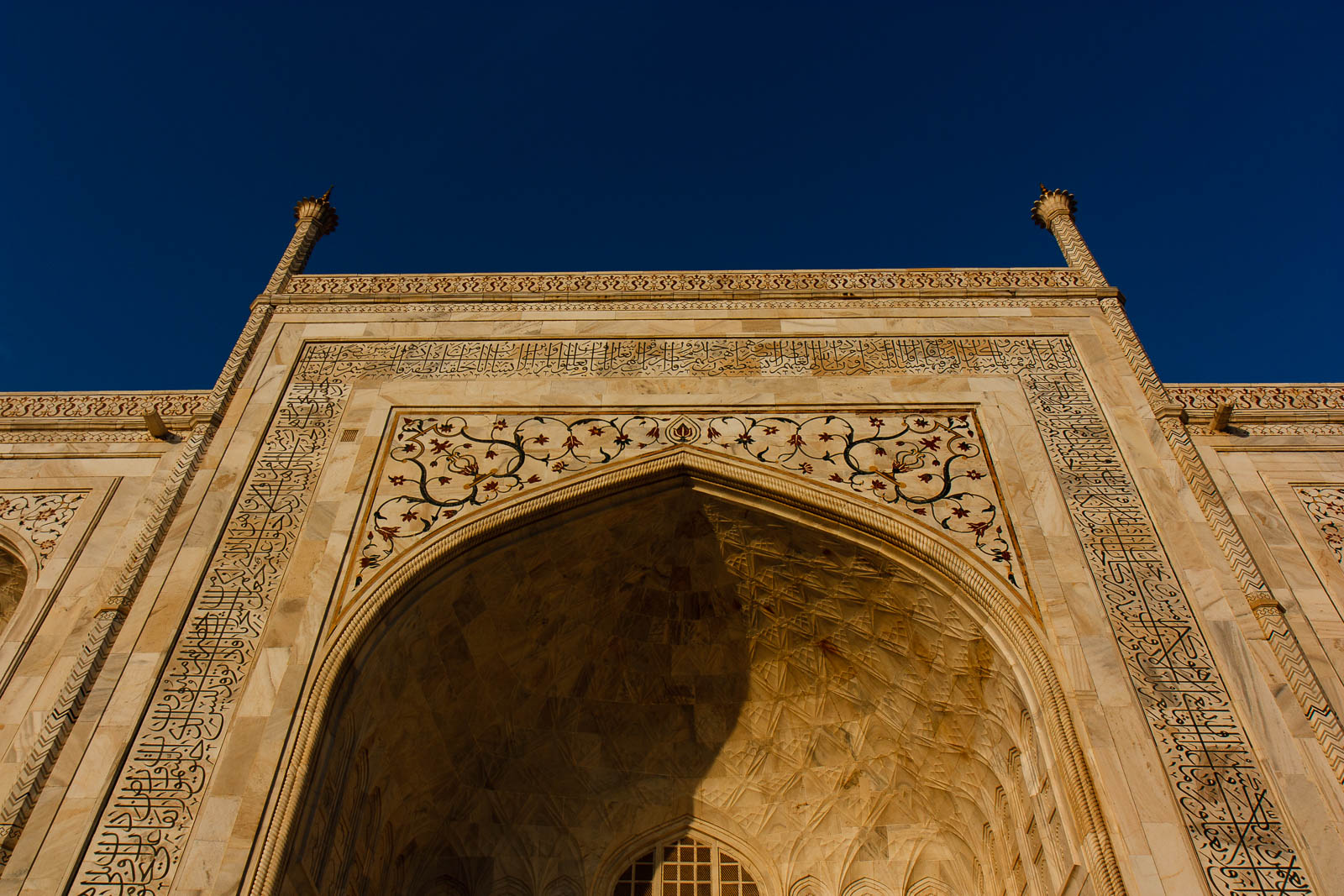
Close up of one of the arches

Detail

One of the screens that let in light into the inner chamber

The inside of the guest house

The inside of the mosque

Dome of the mosque
The main gateway into the Taj - seen from inside.

The main gateway seen from outside.


 You have to have your picture taken with the Taj in the background.


They were having trouble propping up this infant for the picture. He kept falling over.

This one is more stable :)

Questionable stability.

Tuesday, December 16, 2014

Akbar's city and grave

Panch Mahal : 176 columns support this five storey structure
In Indian history, Akbar the Great, the third Moghul emperor, is the real deal. A great general, administrator, patron of art and intellectual, he brought much of current India (down to the Deccan) under his rule. He was a secularist and created a synergistic religion, that sadly, did not survive his death.

We visited the city he created as his capital in 1569 - Fatehpur Sikri. A beautiful city, the location had too many challenges and the capital moved to Lahore in 1585. Just a 16 year stint. There's definitely precedence here for government wastefulness! Fatehpur Sikri is about an hour's drive from Agra.

Entrance to Mariam's Palace

Mariam's Palace - inside courtyard

Mariam's Palace - carving detail

Birbal's house - a gem!

Carving detail at Birbal's house. Everything is carved like this.

Turkish Sultana's House

Detail: Turkish Sultana's house

To get a sense of the scale (Wikipedia has a great panorama)

Ibadat Khana
Ibadat Khana - Akbar is said to have sat at the center spot & discussed theology with scholars at the four ends. Sounds very James Bondish to me.

Entrance gate to the Jama Masjid

Tomb of Salim Chishti, the sufi saint that drew Akbar to Fatehpur

Beautiful marble screens in Salim Chishti's tomb

From the inside. Women wanting children tie strings to some of the interior screens.

The huge courtyard of the Jama Masjid. This is where people gather to pray (it is a functioning mosque)
One of the few things I remember from my visit at age 15. The impressive Bulund Darwaza - an entrance to the Mosque from the town.

Bulund Darwaza is at the top of a steep flight of steps & it is quite an experience to look up at it.

Akbar started construction of his tomb in Sikandra, just outside Agra, during his lifetime. It followed the familiar (to readers paying attention!) pattern of a square walled off space with grand entrances, a garden divided into four with water ways (a char baug) and a mausoleum that housed his grave as well as others close to him. I thought the tomb had a lot going on and wasn't anywhere as harmonious a design as his father Himayun's tomb in Delhi.
Main gate to Akbar's tomb


The Mausoleum

These antelopes were all over the garden

Interior of the mausoleum
Tomb of Akbar's daughter. Akbar's tomb is unadorned.

Saturday, December 13, 2014

Agra beyond the Taj

Agra is the dirtiest city that I've seen in India. Garbage everywhere! And the constant harassment from vendors, autorickshaw drivers, guides and just people who want you to do something you don't is exhausting. The perfunctory security checks that do nothing but give the guys doing them a job and the dour, unfriendly faces behind the ticket counters for the sights are enough to make you want to head right out of town.

But, it is an ancient city and was the capital of the Moghul empire for over a hundred years and they left their mark here. There is a lot to see besides the Taj and we tried to cover some of it in the two and a half days we had here.

Then there are the honest, friendly people that you encounter. Auto-rickshaw drivers like to cheat you out of money by pretending not to have any change. So I make it a point to ask if they have change before we hire them. This one guy was so offended by my question that he handed me my change before we got into his rickshaw & started a tirade against the crooks in his trade that lasted the whole ride.

You need your imagination to appreciate Chini-ka-Rauza, the tomb of  Shah Jehan's prime minister. It was once covered in glazed tile, but sadly only portions remain. The painted interiors have somehow survived, and give a glimpse of what it looked like way back when I was young.
Chini-ka-Rauza - a couple of clowning kids always adds to the fun. Very little of the glazed tiles remain.

Chini-ka-Rauza : The painted dome.

Chini-Ka-Rauza

Chini-Ka-Rauza

Itmad-ud-Daulah was Shah Jehan's father-in-law (one of many!!) and also Mumtaz Mahal's (of Taj Mahal fame) grandfather. His tomb site is similar to many we've seen with a central mausoleum that holds the grave, a large square garden surrounded by high walls and divided into quadrants, and one of more elaborate entrance gates. This one was very beautiful with inlaid stone (pietra dura).
The entry gate to Itmad-ud-Daulah

Itmad-ud-Daulah
The beautiful stone work & Tami, of course

Details

The Agra or Red Fort stands at a location that has had a fort for over a thousand years. This one was built in red sandstone by Akbar when he made it his capital. Subsequent rulers, especially Shah Jehan added to it substantially. Shah Jehan was imprisoned here in his last years by his son Aurangzeb, who overthrew him to be king.
Agra Fort
Entry gate - I love the color of the sandstone in the late afternoon sun
Diwani-Am

Inside the Diwani-Am

Diwani-Am - Emperor's seat
Detail of the emperor's seat


Only the stains from the paintings remain


This is what it would have looked like

The Musamman Burj where Shah Jehan was imprisoned.

Shah Jehan could see his beloved Taj from his 'prison'.
Jehangir Palace - beautifully made of red sandstone
Detail of the palace walls
Courtyard along the river

Detail

Detail

Tami in the palace

More detail - the carvings were spectacular!

In high school, Father Morondo - a favourite of all the students - taught us history. He used to strut around, ride chairs like horses and bring history to life. He's retired now and lives near his home in Spain.

I found out about Agra's Roman Catholic cemetery from this wonderful blog and we found it after a long rickshaw ride. It was small, but definitely worth visiting. The cemetery goes back to the time of Akbar and has Armenian Christians (who were traders) buried here. It is still in use.
John William Hessing's tomb